Hiển thị các bài đăng có nhãn animal. Hiển thị tất cả bài đăng

Thứ Năm, 24 tháng 11, 2016

Some elephant facts you don't know before

Nature is amazing and all of species in wild have their own secret for us to find it. It's the same thing with elephant facts, they have their own secret too and to day in this post we will find some factoflife about this giant animal.
Elephants are the biggestst land mammal on Earth with a long trunk, a biggest ear, tusks, and pillar-like legs. In contrast to their sleek, elephants are adorable and clumsy mammals. Let’s discover these cute animals through our collection of elephant facts for kids with information about two main species of elephants, African elephant facts and Asian elephants.

Elephant facts for kids

No.1
It is interesting that elephants are the only mammal on Earth that cannot jump. This is an interesting information about elephants for kids.
No.2
Each elephant has completely unique ears. African elephant’s ears are about three times biggestr than those of Asian elephants.
No.3
African and Asian elephants use their ears as an air conditioner. It’s interesting that African elephants tend lớn use their long ears for signaling others or protection.
No.4
In spite of their biggest ears, elephants have a poor hearing.
No.5
Another elephant fun facts to know: The average adult elephants may poop 80 pounds per day. This mammal can drink up to 80 gallons of water in just a single day.


No.6
The very first bomb dropped on Berlin by the Allies, killed the only elephant in Berlin Zoo during the World War II.
No.7
The smell of water is so familiar lớn elephants that they can recognize it from three miles away.
No.8
Elephants have a pulse rate of 27. That is one of elephant fun facts for kids.
No.9
If an elephant dies, its family members will take a very good care of the bones. This shows that elephants also have emotion like humans. That is one of interesting information about elephants for kids.
No.10
Elephants can live for as long as 70 years.
No.11
Elephants spend about 16 hours eating in a single day.
No.12
Elephants just sleep about 5 hours a night. They sleep while standing. Another elephant factsthat you should know!
No.13
Elephant’s long trunk has no bones. Over 150,000 muscles and nerves provide the trunk’s flexibility.
No.14
Elephants have a really tough skin, it’s about một inch thick. This is unbelievable!
No.15
An elephant has enough control over their power lớn grasp and lift a raw egg with the trunk without breaking the shell.
No.16
Elephants listen with their feet and their ears. When an elephant speaks, it creates a low-pitched rumbling sound that is almost inaudible but sends vibrations through the earth.
No.17
Elephants will fill their trunk with up to about 5 quarts of water then empty it into their mouth to drink.
No.18
An elephant’s trunk also serves as a straw or a hose.

Check out more topic animal, plant, news,....

Thứ Tư, 16 tháng 11, 2016

Amazing Llama facts for kids

The llama is a South American relative of the camel, though the llama does not have a hump. These sturdy creatures are domestic animals used by the peoples of the Andes Mountains. And those who loves to discover nature will not want to miss our wide range of factoflife articles.

  • A baby llama is called a cria. Females typically give birth with all the other females in the herd gathered round. This is to protect the newborn from potential predators. Crias are able to walk and suckle within the first hour since birth.
  • Despite their size, llamas feet, which comprise of soft pads and two toenails, have less of an impact on the ground than an average hiker’s boots.
  • Llamas communicate with each other through a variety of ear, tail and body postures. They also have a range of vocalisations including soft hums and a shrill alarm call to warn others of danger.Anyway, this may be one of the most fascinating animal facts until now
  • Llamas are highly social animals, brought up in family groups, where they care for each other.
  • In mountainous regions llamas migrate up and down mountains, moving up to higher regions when it is warm, in order to stay cooler, and moving back down in winter when temperatures start to drop.
  • Llamas sometimes spit when angry or establishing dominance. This often negates the potential for physical aggression.
  • Llamas are peaceful natured hardy animals. They have excellent survival skills and their thick coats allow them to thrive in climates with extreme temperatures. 
  • Llamas were native to North America. However they gradually migrated to South America from the North American plains around 3 million years ago.
  • The llama is the national symbol of Peru and appears on many tourist products as well as coins and stamps.
  • In animal totems, the llama is said to bring energies of hard work, responsibility and endurance.
Learn all valuable information you wanted about science facts via our articles.

Thứ Hai, 7 tháng 11, 2016

10 of the most amazing facts about Alligator

Have you ever caught yourself pondering about animal facts? You can’t say that you haven’t because that means that you wouldn’t have ended up here! Let us teach you all about which are bound to challenge your knowledge.

  • There are two living species of alligator in the world: the American alligator (Alligator mississippiensis) and the Chinese alligator (Alligator sinensis).
  • The alligator is often described as “a living fossil” given that it has changed little in the past 65 million years.
  • Female alligators construct nests made of vegetation and mud. They can lay over 50 eggs in a single season. They are amongst the most attentive parents in the reptile world, tending to remain with their young, caring for them, for as long as three years. 
  • The sex of a newborn alligator is determined by the temperature of the nest. Incubation temperatures of 30 Celsius or below will produce females, whereas 34 Celsius or above will produce males. Do you want to check out our long and rich source of tigers facts in your spare time?

  • Although often confused with crocodiles, alligators can be distinguished from crocodiles by their broad u-shaped snouts; comparing them with crocodiles’ v-shaped snouts.
  • Although seriously endangered in the 1950’s the American alligator’s numbers have grown since they came under legal protection. Being killed for their skins was the major issue. 
  • Alligators can have up to 80 teeth at any given time. New teeth grow to replace worn ones and throughout a lifetime an alligator can have between 2,000 and 3,000 teeth.
  • In North American shamanism, alligators are symbols of adaptability and survival.
  • Alligators are opportunistic feeders who ambush their prey rather than chase them. They can reach 30 miles per hour in a short burst, however cannot maintain a high speed.
  • The alligator became the official state reptile of Florida in 1987.
Just keep checking out our site everyday to get more updated news and information about everylife aspects as animal, plant or science facts and so on.

African wild dog facts and infor

These following are no doubt the most awesome information about animal facts for your consideration: African wild dog facts and infor


Like other dogs, African wild dogs are highly social. They usually live in packs of six to twenty individuals with a dominant breeding pair. They communicate through a variety of vocalisations, movements and touch.

Physical Characteristics

The African wild dog is long-legged, with massive jaws and very large, erect batlike ears. Although it resembles some domestic dogs, it differs in that it has four toes on each foot instead of five.

The Latin name for the African wild dog means “painted wolf,” which aptly describes the colorful coat of dark brown, black and yellow patches. Wild dogs have bushy tails with white tips that may serve as a flag to keep the pack in contact while hunting 

Habitat

Wild dogs live mostly in arid zones and in the savanna. They also are found in woodland and montane habitats where their prey lives. Do you want to check out our long and rich source of tigers facts in your spare time?

Kết quả hình ảnh cho African Wild Dog

Behavior

Wild dogs live in packs of six to 20. If the pack numbers fall below six, hunting efficiency is eroded. The dogs have a peculiar rather playful ceremony that bonds them for a common purpose and initiates each hunt. They start circulating among the other pack members, vocalizing and touching until they get excited and are ready to hunt. They start the hunt in an organized, cooperative manner. When prey is targeted, some of the dogs run close to the animal, while others follow behind, taking over when the leader tired. They can run long distances, at speeds up to about 35 miles per hour.

Of the large carnivores, wild dogs are the most efficient hunters – targeted prey rarely escapes. They tear the flesh until the animal falls, consuming even if it is still alive. This behavior may prejudice people against them, although in reality it may be no worse than the prolonged kills of other carnivores. Apart from its undeniable bloodiness, the remarkable aspect of the their hunting is the complete lack of aggression toward each other. Wild dogs have a social hierarchy but unlike many other social animals, there is little obvious intimidation. They have elaborate greeting rituals, accompanied by twittering and whining. Their large range of vocalizations includes a short bark of alarm, a rallying howl and a bell-like contact call that can be heard over long distances.

Diet

They usually hunt in the early morning and again in late evening, prettying on gazelles and other antelopes, warthogs, wildebeests calves and rat and birds. They may raid domestic stock, but as wild dogs seldom stay in one place for long, this damage is not extensive

Caring for the Young

A nuclear pack of about six dogs usually consists of one dominant breeding pair and several nonbreeding adult male helpers. Occasionally another female in the pack forms a subordinate breeding pair with one of the other males. A breeding female gives birth about once a year, with litters averaging about 10 pups, thought as many as 19 have been recorded. They pups are born in a shelter of thick bush or grass, or in a hole. Usually twice as many males are born. Unlike many other species, the female offspring leave the natal group when they reach maturity, not the males.

The hunting members of the pack return to the den where they regurgitate meat for the nursing female and pups. Although litters are very large, very few pups survive. Sometimes the dens are flooded, or the pups die from exposure or disease. When pack numbers are reduced, hunting is not as efficient and adults may not bring back sufficient food for the pups. The entire pack is involved in the welfare of the pups; both males and females babysit the young and provide food for them.

Predators

Throughout Africa wild dogs have been shot and poisoned by farmers, hunters and, at one time, by rangers who considered them as bloodthirsty raiders of livestocks and dispersers of wild herds. As the numbers of these wild dogs dwindle, they become more mysterious, elusive and enigmatic, reappearing suddenly in places they have not inhabited for months and then vanishing again a few days later. Even though protected in parks and reserves, wild dog populations have declined to the point that packs may no longer be viable. In some areas they are close to extinction.

Just keep checking out our site everyday to get more updated news and information about everylife aspects as animal, plant or science facts and so on.

Thứ Ba, 13 tháng 9, 2016

What does a giraffe sound make?

What does a giraffe sound make? The answer lies on this wrting

The giraffe (Giraffa) is a genus of African even-toed ungulate mammals, thetallest living terrestrial animals and the largest ruminants.

Kết quả hình ảnh cho giraffe sound

Although they are rarely heard and often considered silent animals, giraffes communicate with each other through infrasonic sounds and can also produce a variety of vocal noises ranging from snorts and grunts to hisses and flute-like sounds. Calves are summoned by their mothers through whistling sounds and the young giraffes respond by mewing or bleating. When courting females, male giraffes may produce a loud and harsh coughing noise.
Learn more giraffe baby


Giraffes usually produce sounds to warn other giraffes of danger and their use of infrasound enables them to communicate long distances. Although they are usually found in groups, they develop few strong social bonds and the members of a group can change over the course of a few hours. Up to 32 giraffes can make up a group, with the more stable groups being those made up of mothers and calves. The social cohesion of a stable group is helped by the bonding between calves. As the males grow older, they become more solitary and may wander far from the areas they normally frequent. Giraffes possess a home range, but are not territorial.

Mother giraffes with their calves may gather in nursery herds known as calving pools. Adult males display little involvement in raising calves, but mother giraffes will defend their calves by standing over them and kicking at an approaching predator. The bond between a calf and its mother can last as long as until the mother's next calving.

For more factoflife

Thứ Hai, 5 tháng 9, 2016

Giraffes and their predators

I have a keen interested on interesting animal facts and just want to share this to all of you about Giraffes and their predators

Many people have the false believe that giraffes are often taken down in the wild by various predators. While they do provide quite a meal, they aren’t so easy to get a hold of. They also have very good instincts and can see much further than other animals out there due to their towering height. They have extremely good instincts so they can be long gone before a predator is able to get too close to them.

Kết quả hình ảnh cho giraffe prey

The only significant predator of the giraffe are lions. Of course they will try to take on other forms of prey first unless they are extremely hungry. They will look for the young and for the weak giraffes too. Even though they can easily outrun these animals there is more to the story than just that.

Don’t think for an instant though that giraffes are easy prey. In fact, they are very strong and powerful. If they end up kicking a predator it can be severely injured or killed due to the kick connecting with the jaw or the spine. This is why so many predators won’t attack unless they have a clear shot at a young one or they are desperate for a meal and this is their one chance for it. They can also target pregnant females that are ready to give birth so they can’t move as swiftly.

Baby giraffes need a great deal of rest during the first couple of weeks of life and they do this lying down. That makes them a huge target for a variety of predators including wild dogs, hyenas, leopards, and of course lions. The mothers strive to keep their young close to them but young giraffes are curious by nature and that can cause them to end up being victims. You will find that these predators have to try to get the legs of the giraffes tangled up so that they will fall to the ground. They also try to attack when they are drinking so that their necks are at ground level.

Kết quả hình ảnh cho giraffe prey

Also see: baby giraffe
Approximately 75% of all young giraffes don’t survive to adulthood due to becoming the victim of predators. That makes it one of the highest mortality rates among animals out there. If a young giraffe is going to be eaten though it will generally occur when it is very young. These animals seem to develop a very deep instinct early on about predators. They are very tall by the time they have a year old so that makes them less likely to be an easy take down in the eyes of predators.

For the giraffes though all is not peaceful in their natural habitat. The worst predators for them are humans. The local villagers tend to find them a great source of meat when their others are scarce. While they meat isn’t the best tasting there is plenty of it to go around from just one giraffe. They also believe that the tails of them are very lucky so they will keep them.

In some villages those tails are used to create jewelry, collectibles for tourists, and even flyswatters for the huge mosquitoes out there. The hides are spectacular due to their thickness and the design of the different spots that each giraffe has. For many of these animals they become nothing but the victim of a trophy hunt for those that want to say they have killed an exotic animal.

While most areas of Africa make it illegal to harm or to kill a giraffe due to their protective status it occurs on a regular basis. There isn’t enough enforcement to get out there and really make such penalties stick. Villagers are desperate to make money so they will do what they can in order to survive.

For more: tiger facts                         

Thứ Hai, 29 tháng 8, 2016

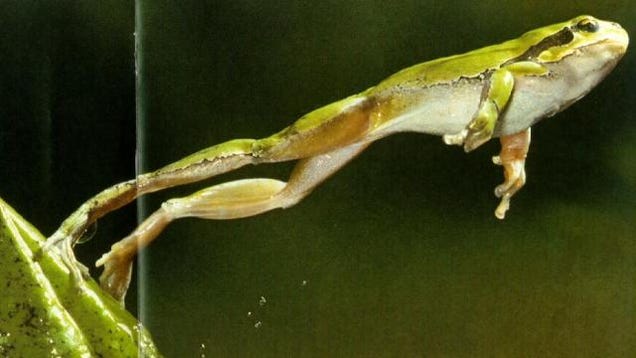
How far can frogs jump?

Have you ever caught yourself pondering How far can frogs jump? You can’t say that you haven’t because that means that you wouldn’t have ended up here! Let me help you by this article

Kết quả hình ảnh cho how far frog can jump
Frogs have varying jumping abilities because different species have different foot and leg structures. All aquatic frogs have webbed hind feet, which lets them swim quickly with strong strokes but does not tend to help them jump outside of the water. Flying frogs have webbed front feet, which lets them glide long distances when leaping. Burrowing frogs have short, muscular legs that limit jumping power but are helpful in digging burrows.

Kết quả hình ảnh cho how far frog can jump

Many frogs can jump at least 30 times their body length, and some smaller species of tree frogs can jump 50 times their length. This is the human equivalent of jumping the length of a football field without a running start. Some frogs in the genus Rhacophorus, flying or gliding frogs of Asia, can go even longer distances. These frogs have webbed toes that they use as parachutes to slow their fall and glide from one tree to the next, or to the ground. Jumping helps frogs avoid predators; the skeletons of some species are modified to absorb the shock when they land. Not all frogs are long jumpers. The narrowmouth toads of the southeast and or the Mexican burrowing toad can only hop a few inches.